Field research · Systems thinking · Publication

Designing mobile money from household financial life.

At Human Factors International, I co-authored published research on how mobile money could support financial inclusion for women in bottom-of-the-pyramid households in urban India. A surviving field-evidence artifact directly connects me to the study’s research archive.

Publication
IDGD 2009 · LNCS 5623 · pages 475–484
Authors
Apala Lahiri Chavan, Sarit Arora, Anand Kumar, Praneet Koppula
My evidence
Confirmed co-author with direct field-evidence contribution
Research frame
Household roles, migration, transactions, barriers, and opportunity areas
Public record
Springer publication page and stable DOI
Outcome boundary
Research contribution verified; shipped service and financial impact unverified

A useful service had to fit how money, trust, obligation, access, and decision-making already worked within a household.

Research frame

Financial behavior lives inside a system.

The study connected individual transactions to household relationships, informal and formal providers, access to mobile phones, migration history, and the products available to low-income urban families.

Household roles

Who holds responsibility, makes decisions, carries risk, and controls access.

Trust networks

Family, community, providers, and familiar ways of moving or storing money.

Migration history

Rural and urban connections that shape transactions, obligations, and service access.

Product fit

The conditions under which a mobile-money service could become useful and credible.

My role

Co-author with a direct link to the field evidence.

Springer’s publication record confirms my co-authorship. A March 2009 participant-documentation deck authored by me aligns by timing and participant reference with a public figure from the paper.

The artifact strongly corroborates my contribution to documenting the study’s field evidence. Responsibility across recruitment, interviewing, analysis, ecosystem modeling, and manuscript writing remains shared or unresolved.

01 / Lives

Begin with the way money already moves.

The research centered women whose financial choices were shaped by household roles, informal practices, limited access, and migration from rural to urban India. It examined the existing transaction ecosystem before developing mobile-money opportunity areas.

This frame gave product design a social and institutional starting point. Access, trust, obligation, control, and risk all influenced whether a service could fit daily life.

02 / System

Map relationships, gaps, and barriers.

The paper’s public abstract describes a progression from women’s roles and financial transactions to gaps in the existing ecosystem, then to challenges and opportunities for mobile money. Migration history helped explain differences in financial behavior.

The ecosystem view connected a person to the family, community, providers, mobile access, and urban context around each transaction. It created a richer unit of analysis than the transaction screen.

03 / Opportunity

Let context define the product paradigm.

The population’s relationships, risk, access, and constraints defined a distinct product model. Trust, control, household roles, migration experience, and the wider network through which money moved shaped the opportunity space.

The design contribution was a way to move from lived financial behavior to service opportunities while keeping social context visible.

Scope: The public record supports the research frame and publication. The surviving archive supports direct field-evidence contribution. Specific product concepts, deployment, and financial outcomes remain outside the verified record.
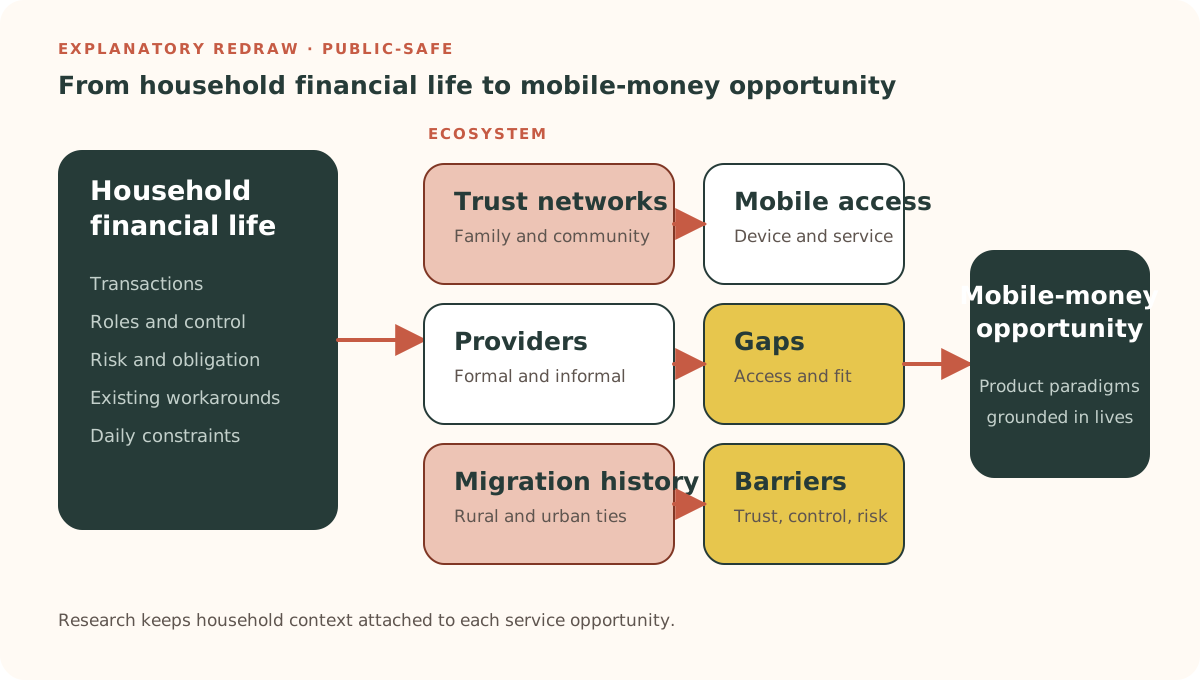
Explanatory redraw

From household life to service opportunity.

This original diagram summarizes the published research frame. It contains no participant name, image, quotation, or household detail.

Pan diagram →Diagram moving from household financial life through an ecosystem of trust, providers, mobile access, and migration to gaps, barriers, and mobile-money opportunities.
Research logicThe study started with household financial life, mapped the surrounding ecosystem, identified gaps and barriers, and developed opportunity areas for mobile money.
Research sequence

Keep the social system attached to the design question.

The published frame offers a durable sequence for research in complex service environments.

  1. Study lived behavior

    Understand transactions, responsibilities, workarounds, constraints, and existing sources of support.

  2. Map the ecosystem

    Connect household roles to providers, trust networks, mobile access, and migration history.

  3. Identify gaps and barriers

    Locate where the current system creates friction, exclusion, risk, or dependence.

  4. Frame product opportunities

    Develop service paradigms grounded in the conditions the research revealed.

What the work produced

A published, traceable systems-research contribution.

The strongest outcome is a peer-visible research record with a stable citation and a recovered connection to its field evidence.

Research
A household-centered frame

The study connected financial behavior to roles, migration, access, trust, and the wider service ecosystem.

Synthesis
A path from barriers to opportunity

The published abstract traces the work from current transactions and gaps to mobile-money challenges and opportunities.

Communication
A citable public artifact

The paper records the work in the IDGD 2009 proceedings with a stable DOI and publisher page.

Outcome boundary: Publication and field-evidence contribution are verified. Service deployment, adoption, financial impact, and each author’s exact division of work remain unverified.

Inclusion changes what a product needs to be.

A fitting service reflects how people make decisions, whom they trust, what risks they carry, and which parts of the current system already help them succeed. That principle continued through my later work in telecom journeys, civic participation, and complex product ecosystems.

Publication, evidence, and privacy notes
  • Springer publication record: authorship, affiliation, venue, abstract, pages, and DOI.
  • DOI: 10.1007/978-3-642-02767-3_53.
  • A private March 2009 field-documentation artifact carries direct Praneet authorship metadata and a strong link to the publication’s evidence pool.
  • Participant identities, photographs, household details, and the original artifact remain permanently private.
  • The diagram on this page is an original explanatory redraw from privacy-cleared claims.

Next: field research for urban mobile wayfinding.

Read the vignette →