Praneet Koppula
Product design leadership · Expert engineering tools · AI design experiments

Complex software should feel clear enough to trust.

I lead design teams and stay close to the work, making expert-level engineering tools and AI-assisted workflows intuitive without hiding the complexity that makes them powerful.

Current focus: hands-on AI design experiments across agent workflows, UX validation, and complex systems.

Make state visible

Users should understand what the system knows, changed, and needs from them.

Earn trust through control

Preview, confirmation, correction, and recovery matter more than artificial certainty.

Scale judgment, not sameness

Standards should raise quality while preserving room for the problem to shape the solution.

Selected work

Systems, workflows, and teams.

These cases show the range of my practice: field research in India, interaction models for specialized products, state-heavy engineering workflows, and mechanisms that improve product quality across teams. Proprietary details are represented with original explanatory diagrams.

AI product vision

An AI partner inside the engineering workflow

I led the UX vision with an engineering lead for an AI assistant in model-based design. The concept went beyond chat: it connected requirements, architecture, implementation, simulation, and explanation while keeping changes visible and reviewable. We tested the concepts with customers through user interviews and validation tests.

AI interaction model Customer validation Trust and control Cross-functional vision
  • Mapped an end-to-end workflow from intent to structured engineering artifacts.
  • Designed confirmation, traceability, navigation, and explanation into the core interaction.
  • Used customer interviews and validation tests to refine the workflow and interaction model.
  • Explored how natural language, requirements, equations, and code could express user intent.
Read the full case study →
Technical workflow design

Making complex model behavior inspectable

Model Slicer helps engineers isolate the part of a large model relevant to a behavior, signal, test objective, or coverage gap. I helped improve its early productization through state-aware interaction design and simulation-aware workflow prototypes.

Detailed interaction design State logic Error states Team alignment
  • Designed interaction rules for starting points, exclusions, conflicts, and conditional constraints.
  • Made data provenance, recalculation, time-window validity, and failure states legible.
  • Used detailed prototypes to gather feedback and align development and adjacent teams.
Read the full case study →
Quality at scale

Turning design judgment into a team capability

Across a large technical product ecosystem, I helped create shared workflow language, reusable review practices, and coaching systems that made quality easier to discuss and improve across product, engineering, research, documentation, and quality teams.

Design governance Critique systems Coaching Product operations
  • Helped guide design-principles reviews across complex product areas.
  • Used independent ratings and facilitated discussion to reduce opinion-driven critique.
  • Built lightweight enablement so specialists could focus on harder strategic work.
Read the workflow portfolio case →
MathWorks case library

Five more views into the work.

Each case separates direct contribution, team-owned work, public product context, and exploratory strategy.

Human Factors International research

Early systems research in classrooms, households, and cities.

These cases use public records, private attribution evidence, and original diagrams. Each page states the role, evidence strength, privacy boundary, and limits on outcomes.

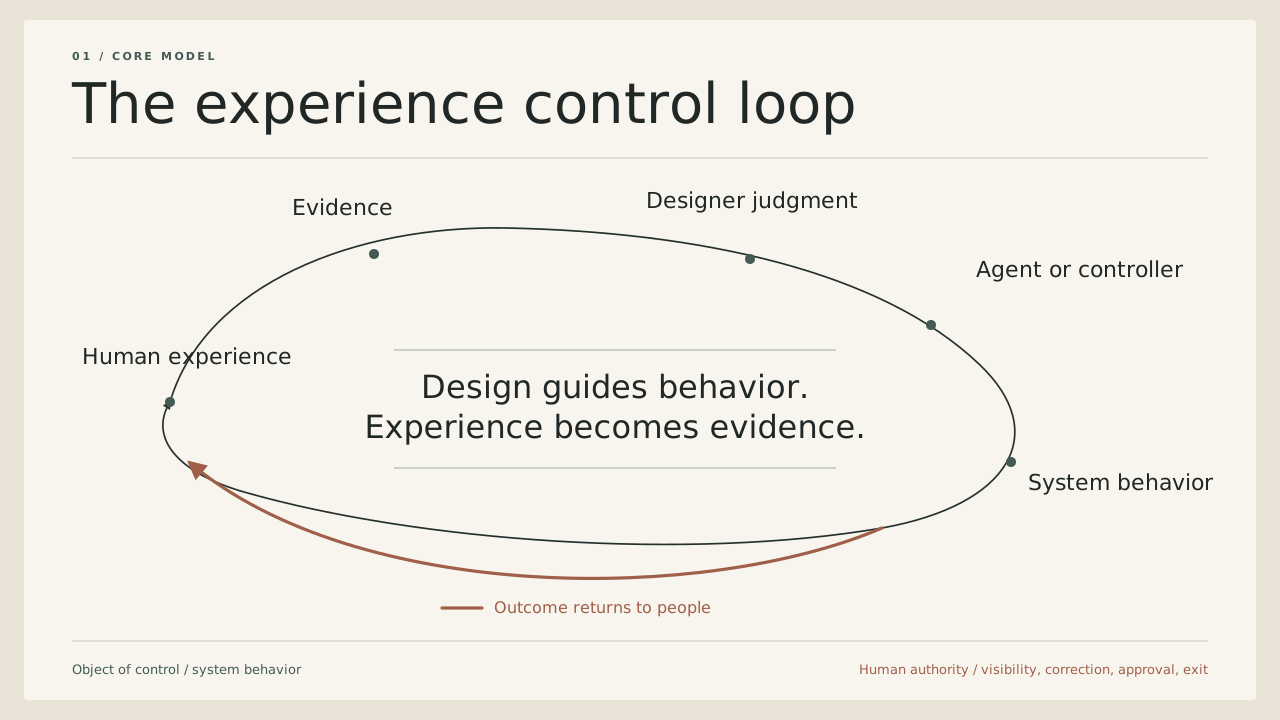
Human experience becomes evidence; design judgment guides an agent or controller; system behavior creates the next experience.
Featured writing · Four-part essay

Closed-Loop Experience Design

I trace an idea from the way I designed beside a developer in 2014 to the way I now build with coding agents, then ask how the same relationship could help designers shape physical system behavior.

Read the essay All writing
Leadership

Grow the people and improve the system around them.

I have managed distributed UX leadership, developed team leads, shaped hiring and coaching systems, and partnered across product and engineering organizations. The aim is consistent: make expectations clear, give precise feedback, and create conditions where designers can take on harder problems.

4countries in the distributed leadership context
120products in the broader governance ecosystem
UXD + UXRteam and leadership development
Hands-onworkflow and interaction direction